AI Glasses | News
Meta and CUPRA show AI glasses that can explain your car when you point at it
A new IFA demonstration uses Meta AI glasses to understand what somebody is looking or pointing at inside a CUPRA Raval and answer product-specific questions. It’s only a showcase for now, but the idea has uses well beyond one car.
By AIWearHQ Editorial Team | Published 1 September 2026
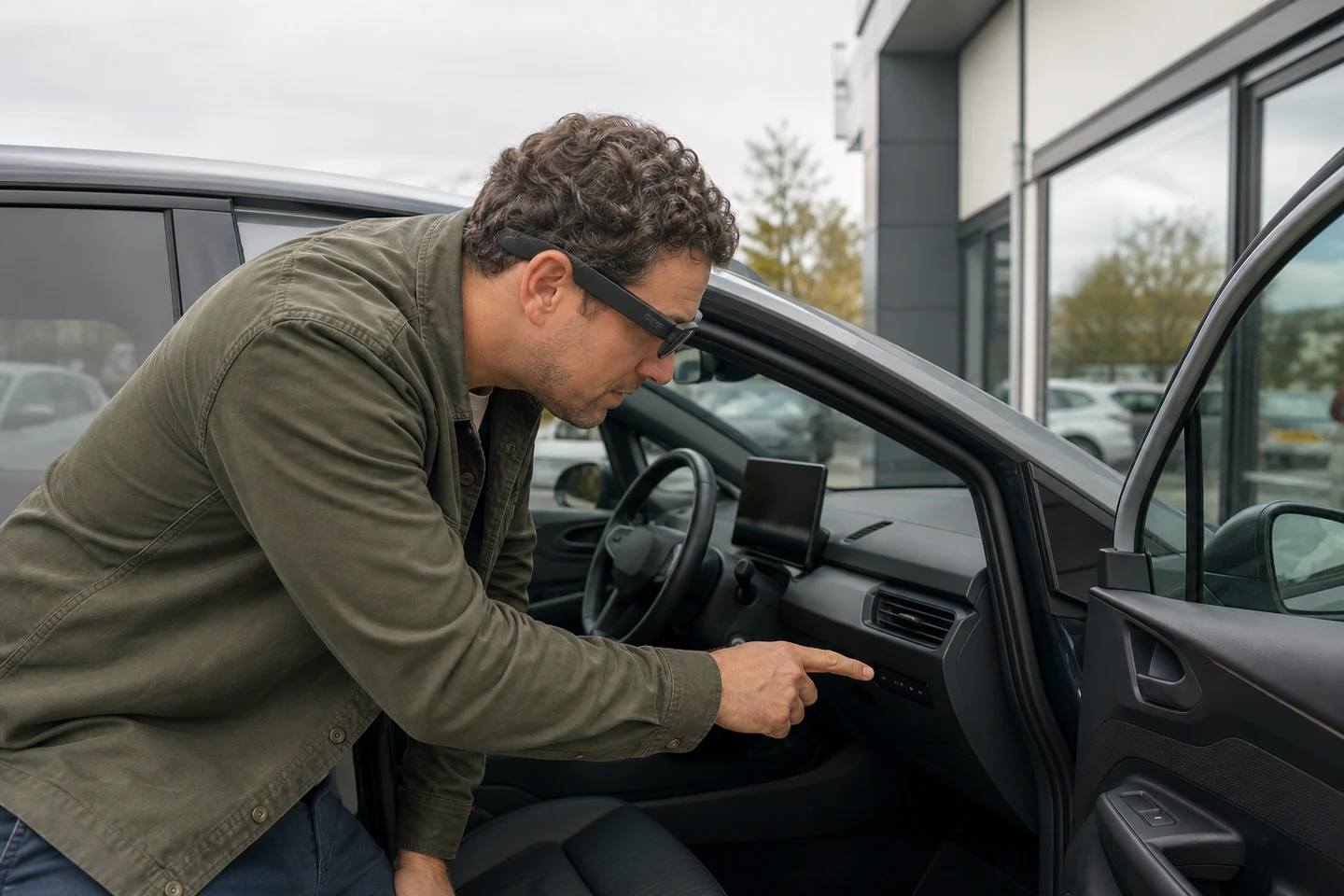
Meta and CUPRA are showing an AI-glasses system that lets somebody look at part of a car, point towards it and ask a question without first knowing what the component is called. Announced on 1 September ahead of IFA 2026 in Berlin, the demonstration was developed by Meta, CUPRA, 1SP Agency and XR Creator Con, combining the view from Meta’s AI-glasses platform with a knowledge base built specifically around the CUPRA Raval. When the wearer looks at an unfamiliar control, points and asks what it does, the software uses the scene, the spoken question and visual cues such as a pointing finger to work out what they mean before searching its Raval information for an answer.
Before getting too carried away, this is an IFA showcase rather than something Raval owners can switch on. It doesn’t read live vehicle data, isn’t connected to the car’s operational systems and can’t control anything, while no consumer release has been announced. IFA hasn’t identified the Meta glasses model used either, so there’s no reason to assume the demonstration is a preview of an update for any current pair.
Looking is easier than describing
Most product searches start with a small problem: you can see the thing you need help with, but you don’t know its name. A symbol on the dashboard is easy to point at and surprisingly awkward to describe in a search box, leaving you to photograph it, upload the image to an assistant and explain what you want to know, or search a manual in the hope that you’ve guessed the right phrase. Glasses remove some of that friction because the camera already shares roughly the wearer’s point of view; if the software understands the scene as well as the question, “What does this button do?” can be enough.
IFA says the demonstration can help with vehicle onboarding, explain controls and functions, guide somebody through settings and answer operating or maintenance questions. It’s a good fit for a device that’s supposed to leave your hands free, particularly when somebody is collecting an unfamiliar car and wants to keep looking at the dashboard rather than move between a screen and whatever they’re trying to understand. That feels like a more believable use for wearable AI than filling a lens with menus and expecting people to operate a miniature version of a phone.
A manual that knows what you’re pointing at
Recognising the object is only half the job. A general AI model may know that it’s looking at a car dashboard, but a confident answer about a particular control needs more than a good visual guess, which is where the dedicated Raval knowledge base comes in. IFA says it covers the vehicle’s design, operation, safety and functions, while technology from Ramblr.ai structures the visual information so the system can interpret objects, activity and context before looking for the relevant answer.
Having the manufacturer’s information available should give the assistant something more authoritative to work with, although it won’t remove every opportunity for error. Documentation can be incomplete, different versions of a product can look alike and the camera may still focus on the wrong control; even so, it’s a better starting point than asking a general assistant to make sense of everything from scratch. CUPRA’s choice of car also makes the demonstration more tangible, because the Raval isn’t a distant concept: CUPRA says it has reached UK retailers and is available for test drives. That doesn’t make the glasses feature commercially available, but it does mean the information layer has been built around a vehicle British drivers can encounter.
The useful idea goes beyond one car
IFA suggests the same approach could work with televisions, washing machines, consumer electronics and more complicated technical equipment. Somebody might point at a socket on the back of a television and ask which cable belongs there, or look at an unfamiliar symbol on an appliance and ask what it means, with the product maker supplying the knowledge while the glasses handle the question and visual context. The value isn’t in making the interaction feel futuristic; it’s in removing the awkward step where somebody has to identify and describe a component before they can ask for help with it.
It’s close to the sort of thing we had in mind when looking at where AI glasses could go next, where we argued that small, purpose-built services may prove more useful than squeezing phone apps into somebody’s eyeline. CUPRA’s demonstration applies much the same principle to a car, although the possibilities extend to any place or product whose owner can provide reliable information. A hotel could explain an unfamiliar thermostat, a rental company could guide somebody through the controls in a car they’ve never driven and a venue could combine directions with information about its own facilities. None of those services has been announced here, but they follow the same pattern: the wearer points at something and the organisation responsible for it supplies the answer.
That sort of short, focused interaction could make the glasses more useful without asking them to become a replacement phone. It lasts only as long as the question, deals with whatever is in front of the wearer and then gets out of the way, which is probably a better fit for ordinary eyewear than keeping a conventional app permanently open in the lens.
There’s still plenty we don’t know
IFA’s announcement doesn’t say how reliably the demonstration identifies small controls, how quickly it responds or what happens when several similar components are visible, nor does it explain how the knowledge base handles different trim levels, software versions or changes made after the original documentation was written. Those details would matter in any commercial version, particularly once the questions move beyond convenience and into maintenance or safety. A confidently wrong answer about a washing-machine programme is irritating; the same behaviour around a car would be considerably harder to shrug off, so safety-related questions would need careful sourcing and firm limits on what the assistant is prepared to say.
Keeping the demonstration separate from live vehicle systems is sensible at this stage, although it also limits the answers. The glasses may recognise a warning or component and explain it using their product information, but they can’t inspect the actual state of the car or say what its systems are reporting internally. There’s no suggestion that this is intended as a driving assistant either, with the examples concentrating on learning about, setting up and maintaining the vehicle rather than receiving information while on the move.
For now it’s a demonstration built around one car, with no release date attached, and there are enough unanswered questions to stop it being mistaken for a finished product. The underlying interaction is nevertheless easy to grasp: look at the unfamiliar thing, point towards it and ask a normal question. That’s a use for AI glasses which doesn’t take much explaining, and it’s likely to be more useful than one that does.