AI Glasses | Feature
Where Do AI Glasses Go Next?
Two years is basically a lifetime in the world of AI. Here’s where we think AI glasses might go in that short space of time.
Trying to predict the next decade of AI glasses would be a pointless exercise. Things are moving so fast that it’s hard to guess what 2036 will bring, what people will have accepted as normal to wear and how much the hardware will have kept up with the software.
Two years still feels worth discussing. It’s long enough for today’s demonstrations to become proper products, but close enough that we can rule out most of the totally crazy stuff.
The starting point is easy enough: Ray-Ban Meta Gen 2 has a camera, microphones and speakers, but no display. Even Realities G2 has a display, but deliberately leaves out the camera and speakers. Meta’s more expensive Ray-Ban Display has already started bringing the two approaches together, while Google has teased its upcoming Android XR glasses both with and without screens.
That gives us a decent idea of what’s technically possible. The next question is what any of that tech will actually be useful for. Here’s our top five predictions for where we go from here.
1. Navigation moves from streets to seats
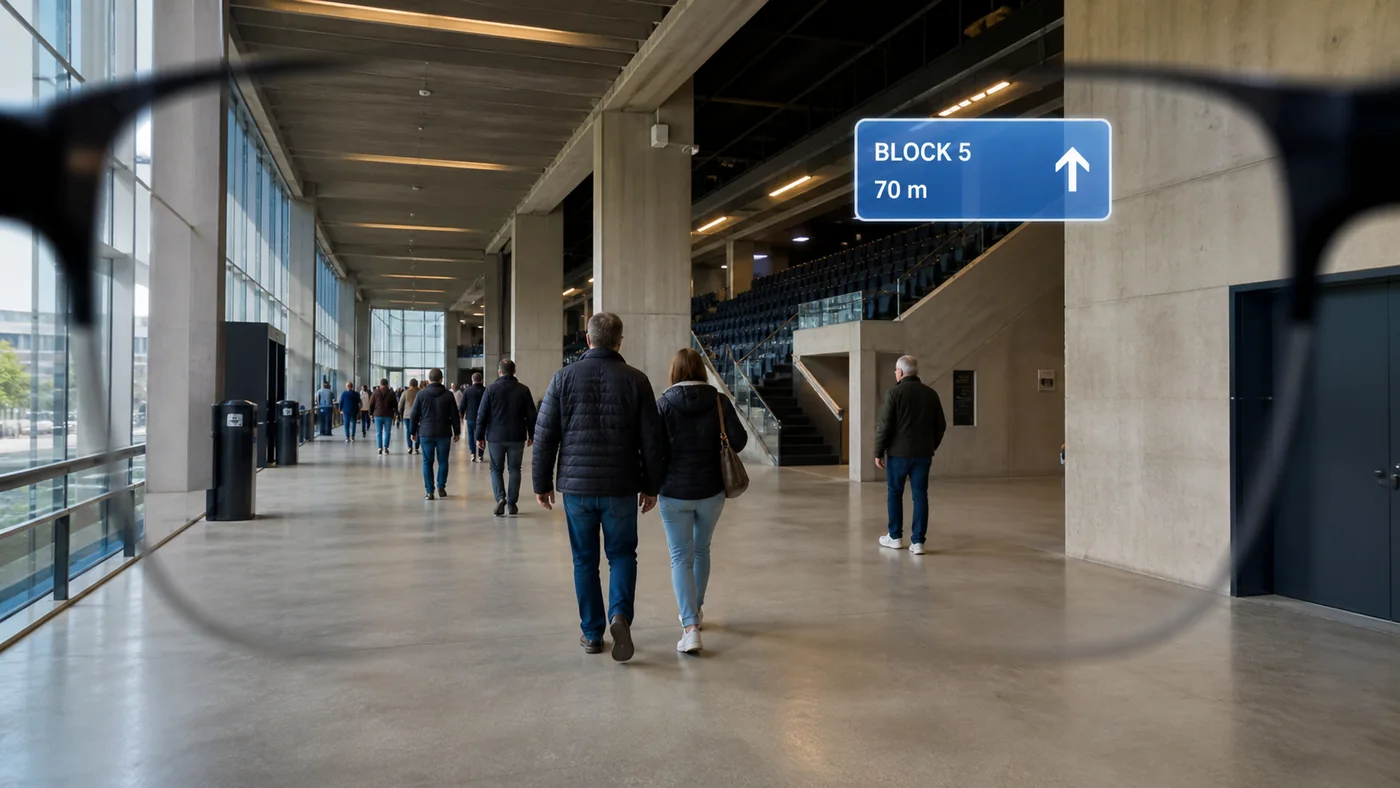
On-screen directions feel like the safest prediction of the lot. Even G2 already puts walking and cycling instructions in front of your eyes, Meta offers pedestrian navigation on its display glasses and Google’s Android XR demonstrations have shown simple arrows and turn information.
Nobody needs a giant glowing route painted across the pavement. A small arrow, the next street name and a distance would be enough, particularly if it saves you from walking along with a phone in your hand.
What if large venues get in on the act, though? An arena already knows where every block, entrance, bar, toilet and merchandise stand is. Its app may also know which facilities are open, whether a queue is building or which route is accessible. Connect that information to the glasses and suddenly a visitor could ask to be shown to their seat, then follow a few quiet instructions through the building, knowing where to stop for their merch, drinks and popcorn.
We haven’t found a major UK venue promising this yet, but it’s got to be on their minds already. The basic ingredients aren’t especially far-fetched. Google Maps already supports some indoor floor plans, while Even, Meta and Google are all giving developers ways to build for their glasses.
2. Video calls become genuinely first-person
Ray-Ban Meta owners can already share the glasses’ camera during a WhatsApp or Messenger call. Switch to the glasses and the person at the other end sees what the wearer sees, which is handy when you’re showing somebody around or need help with something in front of you.
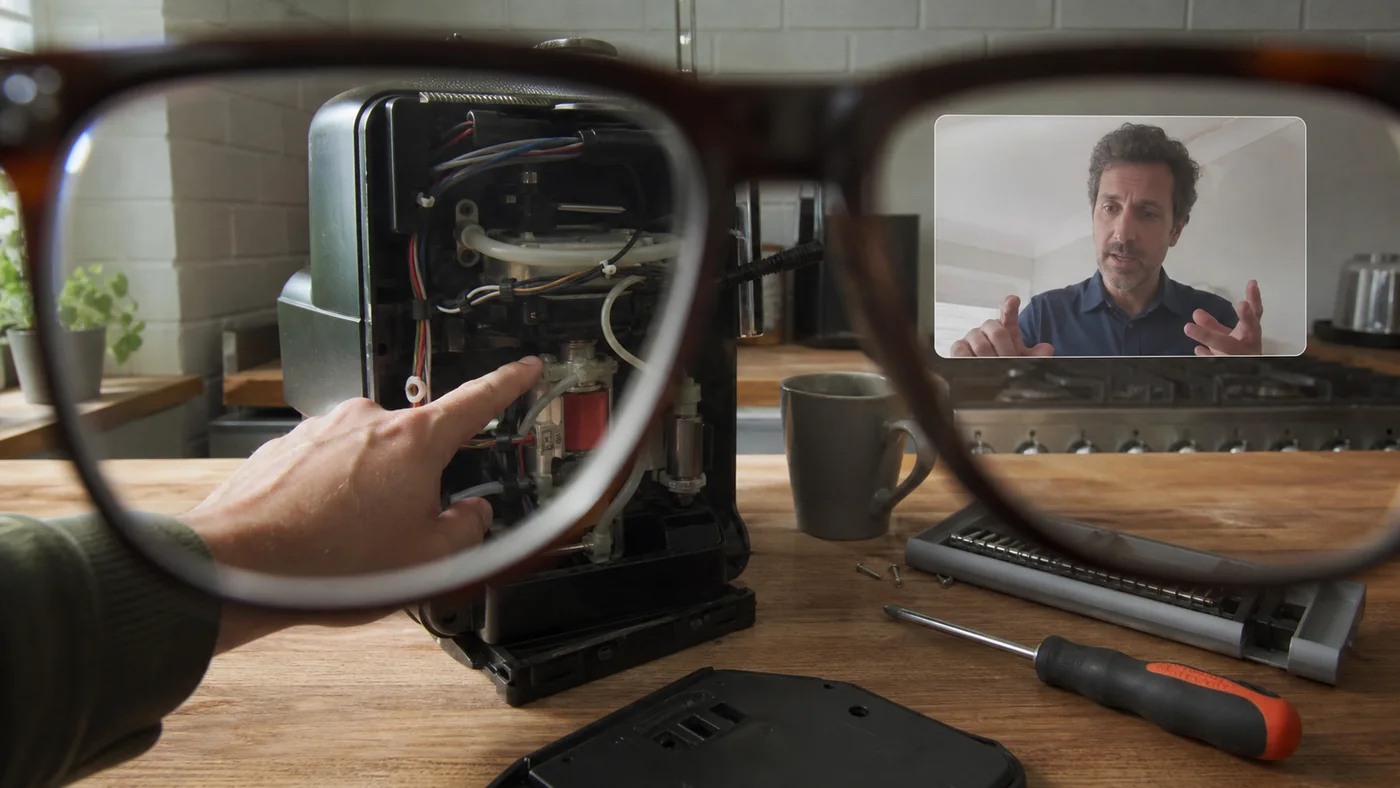
Add a display to the mix and the call now works in both directions. They see your camera view while you see them in a small part of the lens. You could talk to family while cooking, show a friend around a new flat or let your more-talented mate guide you through a repair without trying to grip your phone with your mouth while juggling pliers and a screwdriver.
There are more important uses too. Meta’s work with Be My Eyes already lets people who are blind or have low vision share their camera with a volunteer, somebody they know or a participating support service. A display could add large captions, written instructions or a small pointer without interrupting the conversation. Our feature on Meta glasses and accessibility looks more closely at what people are already doing with the technology.
3. Lenses change tint when you tell them to
Transitions lenses are useful, but they work on their own timetable. Ray-Ban Meta Transitions lenses are great but don’t always hit the tint you want when driving, for example. They react to ultraviolet light, which means they don’t always darken when you want them to and can take a while to clear again indoors.
Electronic tint would make the change your choice. Tap the frame or say “darken the lenses” and the same pair switches into outdoor mode. Walk into a shop and you could turn them clear again without taking them off.
This technology already exists. Chamelo sells glasses with liquid-crystal lenses that change tint using a touch control or an app, so the prediction isn’t that somebody invents it from scratch. The challenge is bringing it into an attractive AI frame while keeping the lenses clear, light, affordable and compatible with prescriptions. Sounds easy, right?
It might not arrive across every range within two years, but it feels like this one could be a natural evolution as manufacturers look to make glasses easy to use inside and outside rather than having to pick between clear indoor or dark sunglass lenses.
4. Zoom helps the wearer, not just the camera
Meta’s display glasses already offer digital zoom when framing a photograph. The next step might be letting the wearer use the same camera to see something more clearly for a few seconds.
Picture the scene: you can’t quite see the train time board, or you’re sat at the back of a show and want to take a closer look. One command and the glasses display changes to take a feed from the camera, zooming in 3x, 5x or even 10x so you can take a closer look. Of course there’d need to be privacy guards, but this doesn’t feel too far off possible.
Specialist low-vision devices such as eSight already use cameras and displays for magnification, contrast controls and colour filters, although the hardware is much larger and serves a different purpose. A simpler consumer feature wouldn’t replace prescription lenses or a proper low-vision device, but it could still be useful to a very wide group of people.
The display is the obvious limit. Small fields of view, modest resolution and battery drain mean this probably works as a temporary mode rather than something you leave running all day. That’s fine. Most people only need long enough to read the sign or take a quick look.
5. Small apps make the glasses worth wearing
The first useful glasses apps probably won’t look much like phone apps. There’s no reason to squeeze pages of menus, adverts and buttons into somebody’s eyeline.
A better approach would be small services that do one job and then disappear. An airline could show a gate change. A supermarket app could keep the next shopping-list item visible. A museum could identify an exhibit, while a train operator could warn that the platform has changed. The arena navigation example is another version of exactly the same idea.
Even Hub already supports third-party plugins, Meta has opened parts of its glasses to developers and Google is building Android XR as a wider platform. These ecosystems are young, and lightweight glasses will still lean heavily on a connected phone for now, but outside developers are likely to find uses the manufacturers haven’t considered. As the ecosystem opens up, so do the possibilities!
An IFA demonstration from Meta and CUPRA now gives us an early example. The glasses combine what the wearer is looking and pointing at with a product-specific Raval knowledge base, letting somebody ask what an unfamiliar control does.
Muse update, 26 September 2026: Meta has since announced that its Muse agent will come to AI glasses, using visual context to help with tasks and carrying on in the background. Asking the glasses to find a replacement part is one of its proposed uses. There’s still no confirmed UK launch date, and the announcement doesn’t promise continuous visual memory. Our Muse report explains what has been announced and what owners are waiting for.
Payments and tickets might become part of this too. Meta has tested small UPI payments through Ray-Ban Meta in India, using the camera to read a QR code before the wearer confirms the transaction. The next generation of contactless might be as easy as looking and saying “pay now”.
The one that feels further out: searchable memory
This is the prediction we’d be a little less confident putting a date on, but it’s also one of the most interesting.
Imagine asking where you parked, what a sign said earlier or where you last saw your keys. Perhaps the glasses remember the name of a restaurant you passed on holiday, or bring back the details of a product you looked at in a shop.
Google’s Project Astra research has explored assistants that retain visual context, while Meta is working with researchers on glasses-based support for people with memory loss. The idea is real enough to take seriously, even if a consumer version is probably quite a way off.
Privacy might prove to be a barrier once again with this one. Glasses can’t remember what happened unless they were watching their surroundings at all times, and your day includes other people, private places and things that shouldn’t be stored indefinitely. This would need obvious controls, short retention options and a very clear off switch. Our feature on the privacy problem surrounding AI glasses explains why the answer can’t simply be to ban the hardware.
A useful future doesn’t need holograms
None of these predictions requires glasses to replace the phone or cover the world in virtual objects. They mostly combine technology that’s already available in one form or another: a camera, a modest display, location data, adjustable lenses and software that understands a little more context. Things that five years ago looked like pie-in-the-sky stuff, straight out of a movie, are now something that might come to market by the time you’ve finished reading this.
By 2028, AI glasses might still look much like the pairs being sold today. The difference could be that they help you find your seat, let somebody talk you through a repair, darken when you step outside and let you watch the big game from row Z like it was row A.
Given the speed AI is opening new doors, we wouldn’t bet against any of it.